CA / CANADAEASTERN TIME · UTC−5
Chai Yuntian
Native gameplay & recorded playback · Art & animation pipeline · Lighting · Chapter integration · Menus · Build & validation tools
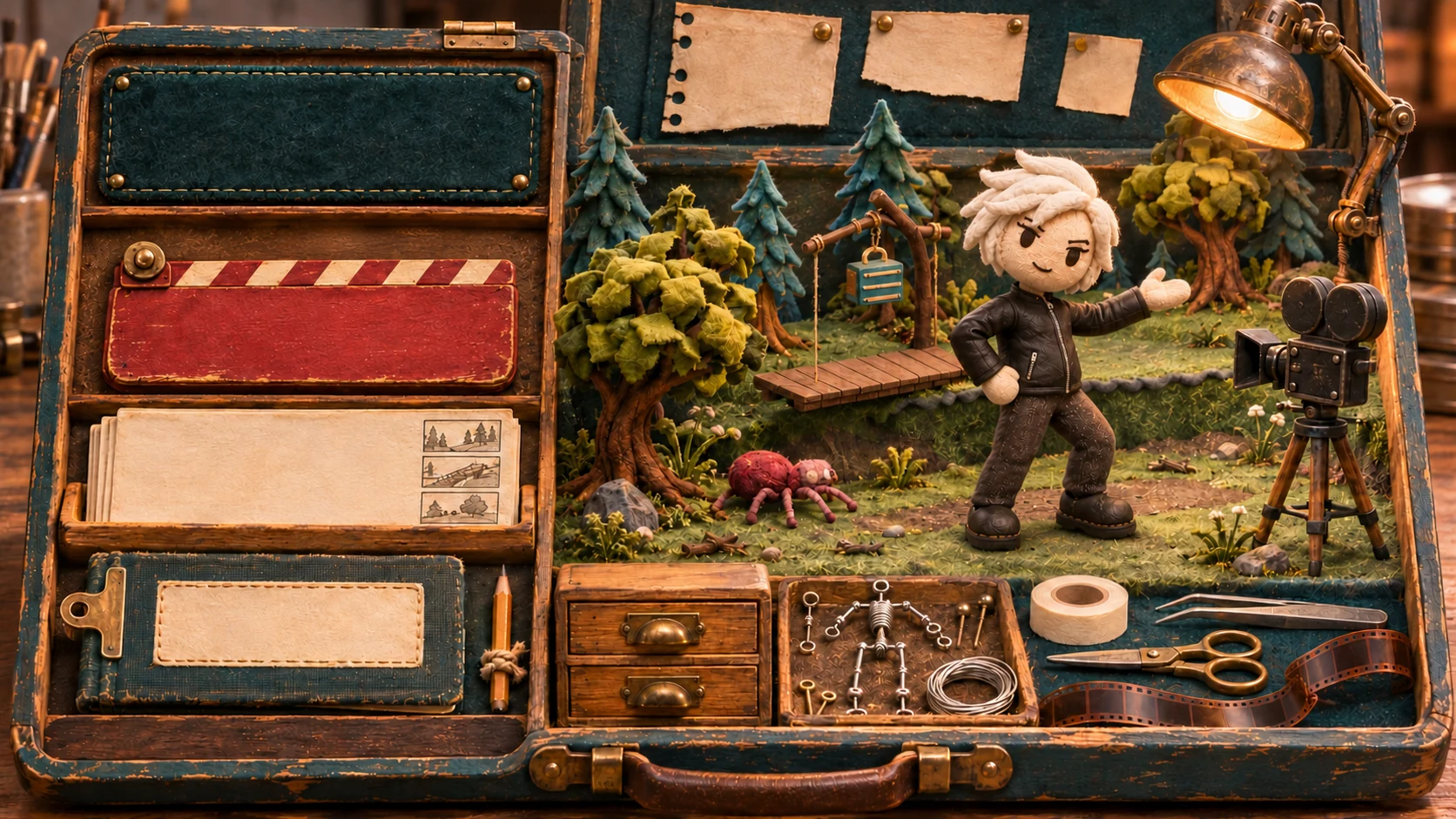
A FOUR-DAY GAME JAM JOURNAL
The making of Leather Jacket Odyssey.
Two creators, working across Canada and China,
turn a little timeline puzzle into a handmade world.
A LITTLE CONTEXT, BEFORE ACTION
You don’t control the traveler.
You edit what happens around him.
Separate a prop’s track. Change its cue. Reverse its motion. Rehearse, then call Action. A successful take becomes the film you directed. That idea was our starting point; the puppets, tiny worlds and long journey home came through iteration.
Chai in Canada. Tian Sang in China. During the jam, Eastern Time and Beijing time were thirteen hours apart. We passed changes between two working days, using shared records and a common main branch to keep the game together.
Native gameplay & recorded playback · Art & animation pipeline · Lighting · Chapter integration · Menus · Build & validation tools
Game concept · Browser level editor · Prototype levels · Tutorials · Timeline interaction · Typography · Sound integration
ONE HANDOFF, IN THE RECORD
On November 13, Tian Sang’s tutorial and audio commit met Chai’s scenery and lighting integration.
Tutorials, editing interactions, saved cuts and audio.
THE MAKING OF / NOVEMBER 2026
From the first falling rock to the final curtain.
A chronological notebook of the work,
including the takes that needed another try.
20 entries · Day chapters use Eastern Time. Switch timestamps to see China’s calendar.
NOV 11 / PREPARATION
Setting the stage.
A shared project, a new engine build, and the beginnings of a film.
Preparation began with Unreal Engine 5.9 MegaJam Preview, Codex integration and editor connections. The repository and initial project established the workspace that both of us would build on.
The history spans two calendars: the initial Unreal project and design-document commit is dated November 12 in China, which was still November 11 in Eastern Canada. We retain that distinction here; these are recorded milestones, not a reconstruction of when every individual asset was made.
NOV 12 / 2026 · DAY 01
A timeline puzzle becomes a miniature world.
The performer keeps moving. You change the cues around him.
Tian Sang’s browser level editor and five authored prototype levels gave the idea a practical shape. Props, paths and timing could be laid out in a scene and exported into the native game.
The starting puzzle was deliberately small: a falling rock, a fixed performer, and a bad take. Removing a threat could make the scene safe; reversing it could preserve an optional reward. A second puzzle asked a flying charge to solve the rock problem through timing.
Observe. Edit. Rehearse. Action.
Chai Yuntian’s six-scene C++ prototype brought removal, reversal and timing changes into Unreal. The team kept the early scope focused on a single-player keyboard-and-mouse puzzle.
Success had to mean more than watching a promising preview. The player would explicitly call Action, complete the performance, and then see the same scene as a cinematic replay.
Recorded milestone. Related work may span several commits.
Read the development record ↗A preview is a promise about what will happen next.
The native workshop imported browser-authored scenes and recorded their simulation at 120 steps per second. Preview, Action and cinematic playback could read the same take instead of producing three slightly different outcomes.
Rewinding needed to restore the whole scene: destroyed props, collected bonuses and event state, as well as positions. Only a successful Action settles rewards. A new edit creates a new revision, so an old result cannot silently stand in for a new cut.
Cloth, timber, plaster, paper and a little theatrical light.
Miniature art, physical interface pieces and replayable breakaway effects gave the greybox a tactile direction. A six-scene editing campaign became the working test bed for reusable stage pieces and deterministic puppet staging.
The kit mattered as much as any single scene. Lifts, carts, bridges and hazards needed to look related, while remaining easy to arrange, replace and inspect.
Recorded milestone. Related work may span several commits.
Read the development record ↗The handmade feeling had to survive the journey into 3D.
Five plush creatures gained native Control Rigs and inverse kinematics. Generated character references moved through mesh preparation, materials, rigs and animation before they could become performers on the set.
A shared Lighting Master, six scene recipes and a modular plaster RockKit brought the environments together. The late-night work was about consistency: wool beside wood, soft figures against readable silhouettes.
Recorded milestone. Related work may span several commits.
Read the development record ↗NOV 13 / 2026 · DAY 02
Two working days meet in one shared game.
A better-looking scene can still be a worse simulation.
Layered miniature backdrops dressed the six-scene prototype. At the same time, contact corrections and recorded outcome comparisons checked that presentation changes did not quietly alter the player’s take.
The visible surface, the physical support and the recorded motion had to agree. That problem would return throughout the jam in feet, rails, rope anchors and moving platforms.
Recorded milestone · approximate time for this work period. Related work may span several commits.
Read the development record ↗Canada → China → one shared main branch.
Tian Sang’s tutorial and audio work landed at 18:33 Beijing time. Chai’s integration followed at 08:50 Eastern / 21:50 Beijing. The handoff combined editing interactions, saved cuts and sound with the miniature scenery and lighting.
Preservation was explicit: authored physical items and catalog entries kept their gameplay fields. Even a squashed bomb silhouette was repaired without changing its physical box. Shared chapter work was a conversation between mechanics and presentation, not a clean division down the middle.
Recorded milestone · approximate time for this work period. Related work may span several commits.
Read the development record ↗The interface joins the set.
Square wooden controls, a hinged Action clapper and larger timeline tracks turned ordinary interface elements into miniature production tools. The scene and the edit needed to feel like parts of the same object.
Frozen story and spatial chapters were integrated with the workshop, then checked in Windows at three interface resolutions. Readability, framing and how much stage remained visible became practical design constraints.
Recorded milestone · approximate time for this work period. Related work may span several commits.
Read the development record ↗Atmosphere has a job to do.
Stale previews and scene framing received attention alongside a lit mine set, local mist and handmade brambles. The visual world grew richer, but the player still needed to read the route and recognize what could go wrong.
Layered scenery and local effects became ways to explain depth, distance and danger. A scene could not depend on a dramatic camera angle that hid the important collision.
Recorded milestone · approximate time for this work period. Related work may span several commits.
Read the development record ↗NOV 14 / 2026 · DAY 03
A cast, a world, and a reason to keep going.
The little stage opens out into cliffs and a cloth sea.
Continuous sculpted cliffs replaced rubble walls, and rescue landings became physical refuges. The Last Light introduced a four-stage maritime puzzle with a rigged whale and a cloth cyclone.
Each new chapter asked for more than a new background. Transport, safe landings and companion rescue had to create understandable chains of cause and effect using the existing editing tools.
Small cues make a complicated scene easier to read.
Tian Sang refined tutorials and wooden controls, introduced Barlow typography, and integrated contact-driven stage Foley. Interaction audio helped edits feel deliberate and physical.
The soundscape combined original procedural cues with separately credited recordings. The licensed stage music, sampled audience reactions and later generated scene themes each retained their own provenance.
Recorded milestone · approximate time for this work period. Related work may span several commits.
Read the development record ↗A white-haired traveler. A worn jacket. A green light waiting at home.
The project’s Director’s Cut concept took on the public title Leather Jacket Odyssey. An animator’s toolbox became the front door to the game, and the loading portrait changed from a stiff pose to relaxed hands in pockets.
The leather title, cloth performer and homecoming scene gave the puzzles a shared destination. The theme moved through the menu, the sets and the ending, while chapter production remained shared between both creators.
Getting yourself home is only part of the story.
The route selected ten scenes while preserving the opening tutorials. The mill and suspended cargo became a continuous puzzle, and later rescue chapters required the companion to arrive alive.
That changed the meaning of success. Reaching the hero’s exit could no longer stand in for a successful rescue. The authored solutions and failure cases needed to match the story the game was telling.
Recorded milestone · approximate time for this work period. Related work may span several commits.
Read the development record ↗Less interface. More stage.
Wheels, rails, winches, ropes, planted feet and stopped poses went through repeated revisions. These small contact details were often where the miniature illusion broke.
The cutting room was compacted, camera choices became Star Cam and Master Shot, and illustrated rolling credits gave both creators equal space. The game’s controls, its cinematic replay and its production story were all becoming more coherent.
Keep the failed take. Learn from it.
Two short Kling videos generated through fal helped inspect walking and idle motion. One did not produce the requested full turn, so it was not accepted as a turning solution.
Those videos stayed visual references. They were not converted into skeletal animation or presented as gameplay footage. The team continued with bounded edits to existing clips, planted idle poses and a dedicated death reaction.
Recorded milestone · approximate time for this work period. Related work may span several commits.
Read the development record ↗NOV 15 / 2026 · DAY 04
The route gets tighter. The checks get stricter.
Finish the code and its companion content together.
The Grand Finale joined the route as an eleventh scene. Successful cinema could continue the journey, and puppet presentation moved to 24 frames per second while the underlying puzzle simulation stayed at 120 Hz.
With many pieces moving at once, the team tightened integration: freeze a handoff, bring code and content into main, then start the next test or recording batch. Every result needed to identify the actual build it described.
Recorded milestone · approximate time for this work period. Related work may span several commits.
Read the development record ↗Fix the cause. Keep the real rules.
Full-route review exposed premature freezes, rescue timing problems and a restored barrel that invalidated an old finale solution. A successful build was clearly not enough to establish that the route worked.
The team investigated timing neighborhoods in the native simulation while retaining the authored geometry and permissions. Reference cuts were corrected instead of moving the exit or weakening the arrival rule. Contact failures that remained were kept visible in the records.
Recorded milestone · approximate time for this work period. Related work may span several commits.
Read the development record ↗An edit to the journey itself.
The standalone water-and-fire scene, The Pour Brigade, was retired. Its teapot-and-fire causal chain moved into The Mill Crossing, giving that chapter another meaningful connection rather than extending the route.
Save migration preserved existing journeys. The first three tutorials stayed in place, and The Grand Finale remained last. The current route returned to ten scenes, with Leather Jacket Odyssey used as the game and window title.
Recorded milestone · approximate time for this work period. Related work may span several commits.
Read the development record ↗Measure, listen, record, and review the actual game.
The final stretch addressed render lifecycle stalls, puppet skinning, warm follow light and green rim light, first-click menu handling, camera layout and native UHD recording. Six outdoor themes were generated with Stable Audio 2.5 through fal.ai and edited into fixed offline loops.
English submission copy, credits and provenance were prepared alongside the game. These changes are part of the development history; they do not turn an earlier package’s passing checks into acceptance of a newer build. Final full-route recording and human review remain distinct steps.
Every finished scene is a collection
of things we chose to change.
FROM THE GAME
Native development captures from the journey.
Different milestones, one visual world.
These are historical development captures, not evidence of final-package acceptance. Click a frame to inspect it.
THE HONEST CHECKPOINT / NOV 15
At the 201aeca integration, Editor compilation and Windows package smoke checks passed. 133 of 134 native checks passed; one coupled-contact check remained unresolved.
Rendering, music, menus and recording changed after that checkpoint. Those older results do not validate the newer build. Full-route recording, listening checks and human playtesting of the final submission package remain separate acceptance steps.
Read the dated evidence ↗Journal source snapshot: c9fdde2
November 15, 2026 · 14:33 EST / November 16 · 03:33 Beijing
TOOLS, MATERIALS & HUMAN DECISIONS
OpenAI Codex assisted C++ and Slate implementation, debugging, content scripts and automated checks. We supplied requirements, inspected the results, revised the work and chose what entered the game.
OpenAI image generation supplied concepts, interface artwork and selected textures. Tripo supplied meshes, textures and humanoid rigging. Blender, project scripts and Unreal handled preparation, animation and integration. Kling clips were motion references only.
Six scene themes used Stable Audio 2.5 through fal.ai, then became edited offline loops. Kevin MacLeod’s licensed stage music, credited sound recordings, procedural Foley and the synthesized homecoming music box remain separately acknowledged.
AI tools supported production. The packaged Windows game runs without a cloud generation service.
Asset credits & source notes ↗
Made across an ocean.
One scene at a time.